


How Will Valuations Be Performed Following IFRS 18
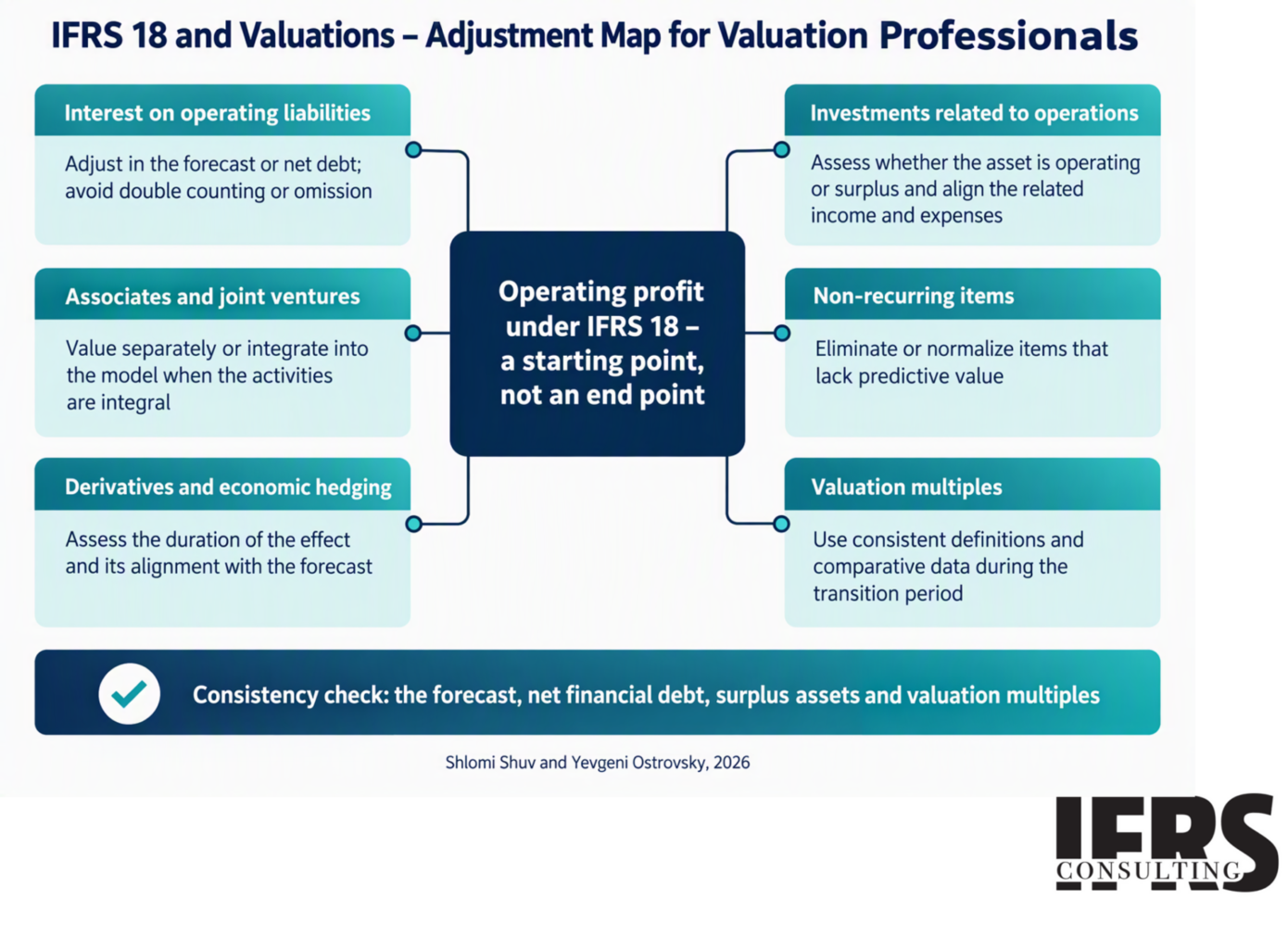
It appears that the prevailing corporate valuation model will be adjusted in light of the change in its starting point-operating profit—following the application of IFRS 18 at the beginning of 2027. Beyond the basic need to use consistent definitions and comparative data when calculating multiples (particularly during the transition period), the focus will be on […]

12 New GAAP Gaps (at least) Expected to Emerge in 2027 Following the Adoption of IFRS 18
While the inclusion of Management-Defined Performance Measures (MPMs) within the financial statements has received significant attention, IFRS 18 introduces another major change: a standardized income statement that groups items into operating, investing, and financing categories. This new structure changes how many income and expense items are classified and presented compared with current IFRS practice. Additionally, starting in 2027, the adoption of IFRS 18 is expected to increase the differences in reported operating profit and EBITDA between IFRS and US GAAP.

Approaching the initial application of IFRS 18: Agile Accounting Planning Can Lead to Growth in Equity and Profitability
Following the absurdity expected to arise upon the initial application of IFRS 18, an amendment to IAS 28 was swiftly completed which creates interesting reporting opportunities through the end of 2026. The amendment permits an otherwise ineligible holding company to make an election to measure associates at fair value, provided they were acquired through a subsidiary whose main business activity is investing in assets. As a result of the amendment, where an ordinary operating company wishes to move from applying the equity method to the fair value model, it can perform a corporate restructuring so that the investment in the associate is transferred to a subsidiary that invests in assets, or it can acquire the associate through such a subsidiary from the outset. This could apply, for example, in the case of an associate whose fair value is significantly higher than its carrying amount, as in the case of an investment

IFRS 18 Implementation Issues: Operating Profit is too Important to be Defined as a Residual Category
In line with statements that preceded the publication of the IFRS 18 and its accompanying explanatory notes, operating profit was the critical trigger for issuing the new standard. Yet paradoxically, the operating category — whose items collectively constitute operating profit — is the only category defined residually, as a default. This residual definition serves as a wide-open back door, permitting (and indeed requiring) the inclusion of income and expenses entirely unrelated to operating activities, such as investment property maintenance costs, credit facility commitment fees, and government grant income. In certain hedging transactions, classification may even be contingent on formal documentation and consequently could be subject to manipulation. To avoid misleading investors regarding the most important category in the new income statement, an independent definition of the operating category should be established.

An Opportunity to Correct the Derivative-on-Derivative Distortion in IAS 32: A Forward Contract to Issue an “Equity Option” should be Classified as Equity, not as a Financial Derivative
The anticipated amendment to IAS 32, which addresses the critical distinction between equity and financial liabilities, should tackle a fundamental distortion in the standard regarding the classification of derivatives on derivatives. Under the standard as currently drafted, and in contrast to US GAAP, a commitment to issue an "equity option" in the future results in the recognition of a financial derivative until the "equity option" is actually issued, even though there is no doubt that the transaction is, in its entirety, an equity transaction. The distortion can be even more severe in a forward transaction to issue a package comprising shares and options, because the distorting requirement to measure the option component of the forward at fair value may drag the share component of the forward into similar treatment. Beyond the distortion in the statement of financial position, since the derivative is measured at fair value through profit or loss,